

The Cercle de l’Éloquence brings Institut Lyfe to life
Published on 23 November 2026
Faire défiler la page16 candidates, 150 spectators, 2½ hours of competition, four winners and one conviction: tomorrow’s leaders will also be those who know how to stand up for their ideas.
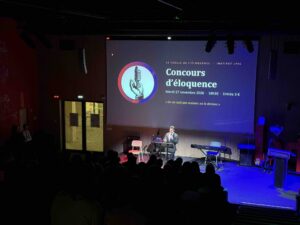 On Tuesday 17 November 2026, the Accor Auditorium at Institut Lyfe was transformed into a stage for self-expression, conviction and emotion. Organised by the Cercle de l’Éloquence, this latest edition of the competition brought together students of all ages and from across different programmes, united by a common challenge: to convince an audience in just five minutes.
For the first time, the event was held in two languages, French and English, marking a turning point in the development of this student association. From passionate speeches and artistic performances to shared moments, here is a look back at an evening that put the power of public speaking centre stage.
An idea can change a life. Words can change a destiny. But silence changes nothing.
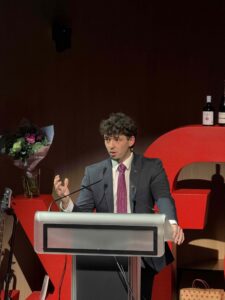
These were the words with which Arthur Blanc, President of the Cercle de l’Éloquence and a fourth-year student on the Bachelor’s in International Hospitality and Restaurant Management at Institut Lyfe, opened this latest edition. His introduction perfectly captured the association’s ambition: to make public speaking much more than an academic exercise.
At Institut Lyfe, we learn how to welcome, how to build businesses, how to manage and how to lead. But how can we expect to lead tomorrow if we do not dare to speak up today?, he asked the audience.
A particularly relevant question at an institution that trains the future professionals and leaders of the hospitality, restaurant and culinary arts industries. Because behind the art of public speaking lie essential skills: the ability to persuade, champion a vision, bring a team together and take a stand.
Eloquence is not simply about words. It is also a school of leadership.
16 candidates, five minutes to convince
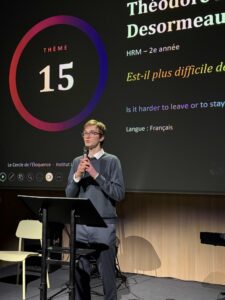 Sixteen students took up the challenge: sixteen personalities, sixteen ways of thinking and just as many ways of standing up for their convictions. Coming from different programmes and years of study at Institut Lyfe, each participant had five minutes to deliver their speech in front of nearly 150 spectators and a panel of four judges. For two and a half hours, speeches followed one another, offering the audience a wealth of reflections, arguments, emotions and personal interpretations.
The 2026 edition stood out in particular for its international outlook. For the first time, candidates could choose to speak in either French or English, an evolution that reflects the cultural diversity of Institut Lyfe and the international ambitions of its students.
Two languages, different personalities, but one shared ambition: to make ideas resonate beyond borders, declared Arthur Blanc in his opening speech.
Topics that challenge the world we live in
 Far removed from traditional rhetorical exercises, the competition was designed to encourage candidates to reflect on universal questions, sometimes challenging, often deeply personal.
The topics included:
- “Can you succeed in life without being successful in life?” An invitation to reflect on our relationship with success, ambition and personal fulfilment.
- “Is it sometimes necessary to disobey in order to do what is right?” A reflection on courage, morality and individual responsibility.
- “What if tomorrow never came?” An invitation to question our relationship with time, priorities and what truly matters.
These were questions with no obvious answers, giving candidates the freedom to develop their own arguments and stand up for their convictions. The aim was not to find the right answer, but to make people think, persuade them and sometimes even challenge their assumptions.
Four winners, four talents in the spotlight
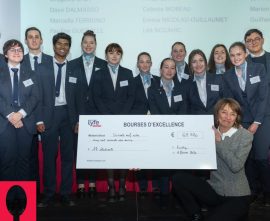
At the end of the competition, four students received awards:
First prize: Varvara Pozhitkova – Daring to discover herself
For Varvara Pozhitkova, winner of first prize, this edition represented much more than a competition: it was an opportunity to step outside her comfort zone, share her convictions and discover a new side of herself. Taking part in her very first public speaking competition, she explains that her main motivation was to enjoy a human experience, driven by the pleasure of expressing herself and connecting with the audience.
Taking part in the Eloquence Competition was a completely new experience for me, and I am very glad I decided to step outside my comfort zone and give it a try.
Winning gave the experience an even greater significance:
Winning first place made the experience even more special, as it allowed me to discover a strength I had never fully recognised in myself: the ability to communicate ideas in a way that brings them to life and resonates with the audience on an emotional level.
A personal discovery that she sums up in a particularly inspiring reflection:
Sometimes, taking a chance on yourself can reveal abilities you never knew you had.
Her testimony perfectly embodies the philosophy of the Cercle de l’Éloquence: giving everyone the opportunity to dare, challenge themselves and discover the power of their own voice.
Second prize: Milana Bayssyeva
Milana Bayssyeva took second place in the competition, in recognition of her commitment and performance in front of the judging panel.
Third prize: Amaury Ollivier
Amaury Ollivier completed the podium, taking third prize in this edition.
Audience Award: Ella Moy
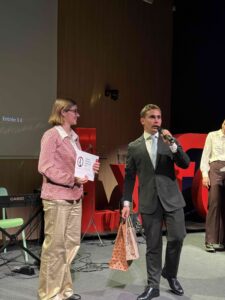 Finally, Ella Moy received the Audience Award, a special distinction recognising the performance chosen by the spectators. This award highlights a fundamental aspect of eloquence: beyond arguments and technique, a speech must also establish a connection with its audience.
Four awards, but above all, sixteen candidates who found the courage to take to the stage. As Arthur Blanc reminded participants before the competition began:
Do not try to be perfect. Be bold. Be sincere. And above all, dare to surprise us.
A panel of four judges to evaluate the candidates
For this edition, the Cercle de l’Éloquence brought together a judging panel made up of four members of the teaching staff:
- Mr Nicolas Tête
- Ms Blandine Joliviet
- Mr Marco Bottura
- Mr Ben Bridgman
Their role? To listen to the speeches, assess their quality and determine the winners.
This edition also had the honour of welcoming Sarah Hachani, Vice-President of the Fédération Francophone de Débat in the Auvergne-Rhône-Alpes region, as guest of honour. Her presence reflects the Cercle de l’Éloquence’s commitment to building connections with regional organisations involved in public speaking and helping this discipline gain recognition beyond Institut Lyfe.
Behind the scenes: two students, one association and a shared ambition
While the audience enjoyed two and a half hours of competition, preparations for this edition had kept the organisers busy for several weeks.
This year, Ambre Begon, a third-year student on the Bachelor’s in International Culinary Arts Management, and Arthur Blanc took over the Cercle de l’Éloquence together, sharing a common ambition: to continue developing the association and take its events to a new level.
Their goal? To create a competition that was more international, more immersive and more deeply integrated into student life at Institut Lyfe.
From designing the programme and coordinating candidates to selecting topics, liaising with the judging panel, managing partnerships, communications and logistics, this edition represented a genuine event management project. It was an experience that brought to life the skills developed at Institut Lyfe: project management, team coordination, creativity, forward planning and a strong focus on the customer experience. But the success of an event like this never rests on a single association. Above all, it is the result of a collective effort.
Le Bureau des Arts: a 360° artistic experience
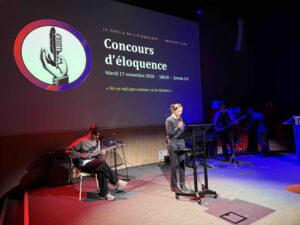 This year, Institut Lyfe’s Bureau des Arts played a major role in shaping the artistic dimension of the competition. Much more than simply providing musical accompaniment, the association delivered a comprehensive artistic experience, bringing together music, photography and video.
With seven different instruments involved, the musical performances punctuated the evening and helped create a distinctive atmosphere inside the Accor Auditorium.
One of the artistic highlights of this edition was a performance of Viva La Vida, the famous song by Coldplay, sung by a member of the Bureau des Arts. A symbolic musical choice for an event dedicated to the power of words and everyone’s ability to make their voice heard.
The Bureau des Arts also provided photographic and video coverage, capturing the candidates’ performances and the competition’s most memorable moments. This collaboration highlights the richness of student life at Institut Lyfe and the complementary talents that come together on campus.
Share Your Stars and Les Coqs: essential partners
Another key contributor to this edition was the Share Your Stars association, which supported the competition’s logistical organisation. Its involvement helped coordinate the event and ensure its smooth running.
Meanwhile, the Les Coqs Sports Association supported the evening by providing a carefully curated selection of food and drinks, specially designed for participants and spectators alike. It was a natural extension of the overall experience, true to Institut Lyfe’s DNA, where hospitality naturally takes centre stage.
These collaborations demonstrate how a student event can become a truly cross-disciplinary project, bringing together associations with complementary skills around a shared goal. Eloquence took centre stage. Team spirit was everywhere.
An association with its sights set on the future
Beyond the competition itself, this edition marks a new chapter for the Cercle de l’Éloquence. By taking over the association, Ambre Begon and Arthur Blanc hope to raise its profile and encourage more students to develop their public speaking skills. Introducing a bilingual format represents an important first step in this direction.
It paves the way for a more international approach to eloquence, particularly relevant at Institut Lyfe, where graduates are expected to build their careers in multicultural environments.
Another objective is to make the Cercle a space where students can learn to stand up for their ideas, build their confidence and find their voice, regardless of their programme or year of study.
Because eloquence extends far beyond competitions. It plays a part in negotiations, meetings, job interviews, decision-making and speeches designed to inspire and unite a team. These are all situations that future hospitality professionals will encounter throughout their careers.
To nurture a generation that does not simply follow ideas, but dares to defend them, challenge them and create new ones.
This is the ambition expressed by Arthur Blanc in his opening speech, and it is what now guides the development of the Cercle de l’Éloquence.
And what if great ideas simply began with someone finding the courage to speak up?
On 17 November 2026, sixteen students dared to take to the stage and four received awards. But all of them helped remind us of something essential: words are a powerful tool for building confidence, expressing ourselves and driving change. In a society where opinions are multiplying and attention is increasingly fragmented, the ability to develop an idea, express it and stand up for it remains an invaluable skill.
As Arthur Blanc concluded in his speech:
Eloquence belongs neither to the most highly qualified, nor to the most powerful, nor to those who speak the loudest. It belongs to those who have something to say and the courage to stand up for it.
A conviction that resonates particularly strongly at Institut Lyfe, because great ideas often begin with someone simply finding the courage to speak up.
Discover student life at Institut Lyfe
Article written by Arthur Blanc
Fourth-year student on the Bachelor’s in International Hospitality and Restaurant Management
and President of the Cercle de l’Éloquence at Institut Lyfe