


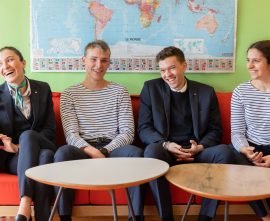
Benjamin Chmura, a graduate of Institut Lyfe: his career in Michelin-starred restaurants
Published on 18 June 2026
Updated on 21 August 2026
Faire défiler la pageBenjamin Chmura, who graduated in 2009 with a Bachelor’s degree in International Culinary Arts Management from Institut Lyfe, has built his career at leading establishments recognised by the Michelin Guide. In 2021, he joined Tantris, a leading institution of French gastronomy in Germany, and was tasked with completely rethinking the restaurant’s culinary offering. A few months after opening, the restaurant was awarded two Michelin stars for Tantris and one star for Tantris DNA: a fine recognition of the successful work achieved.
A look back at a career in which encounters and people have been at the heart of all his experiences and learning.
Could you introduce yourself and tell us about your background before joining Institut Lyfe?
I attended the Lycée Français Jean Monnet in Brussels until I obtained my baccalaureate.
It was around the age of 15 that I started working at weekends in a Michelin-starred restaurant. That first experience was a turning point: it gave me a taste for cooking and the desire to make it my career.
Although I wanted to enrol in a culinary arts school straight away, my parents insisted that I finish my school education first. So I continued my studies whilst working at the same time, and then, once I’d passed my A-levels, I joined Institut Lyfe.
Why did you choose to study at Institut Lyfe rather than elsewhere?
When deciding on my higher education, I took the time to look at several schools in France and Switzerland. I attended various open days, including at Ferrandi, Institut Lyfe and EHL in Lausanne, to compare the learning environments and teaching approaches.
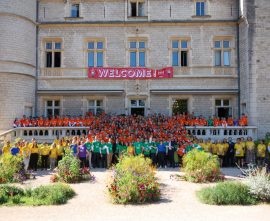
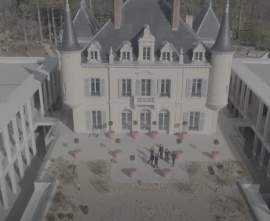
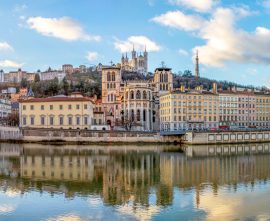
In the end, the choice was mainly based on gut feeling. I immediately had a very good feeling about Institut Lyfe. I discovered Lyon on that occasion, a city I didn’t know at all, and I was instantly taken with it. The school, its setting, the château, the atmosphere during the open days… everything made me want to picture myself studying there.
Discussions with the teachers also played a big part in my decision, as did the quality of the facilities. I particularly appreciated the fact that the course is very cooking-focused, with a real specialisation, rather than a more generalist curriculum. It was all these factors combined that convinced me, and in the end, I made my choice quite quickly.
What skills did you develop during your training?
Above all, I built a very solid foundation, and now I realise just how essential that is. The basics of sauces and vinaigrettes, mastering kitchen tools, but also the professional vocabulary and how to fit into a kitchen team. These are fundamentals that can sometimes be overlooked, yet they are essential for progressing in this profession.
Work placements also played a huge role in my training. Thanks to Institut Lyfe, I had the opportunity to join prestigious establishments such as Guy Savoy and Auberge de l’Ill. These are very demanding experiences, where you have to prove yourself quickly. Coming from a recognised school opens doors, but once you’re there, you have to show what you’re capable of.
Could you tell us about your career path since leaving Institut Lyfe?
I began my career at the Auberge de l’Ill, where I was hired as a kitchen assistant following my work placement. I then joined Frédéric Simonin in Paris for the opening of his restaurant, a highly formative experience during which I stayed for over a year and a half.
At the time, my aim was to join Yannick Alléno’s team. So I joined Le Meurice, before continuing my career at the George V under Éric Briffard, which had two Michelin stars at the time: I worked my way up there, from commis to chef de partie.
After that, I went abroad, first to London and then to Australia, to a Japanese restaurant in Noosa, Queensland. That experience was particularly memorable: I had to learn a different culinary culture, a different way of organising things and a different way of working. The setting was exceptional, with incredible local produce and an approach that was very close to nature.
On my return to France, I joined Troisgros establishment. I started there as sous-chef before becoming head chef. It was a few years later that I met the owners of Restaurant Tantris in Munich.
At that point, I was thinking about the next step in my career: should I stay at Troisgros, open my own restaurant, or take on a new challenge? Although I am of German origin, I had never actually lived in Germany and my career had been heavily influenced by French gastronomy. But the Tantris project immediately appealed to me.
Tantris is an institution in Germany, an iconic venue that has played a major role in promoting French gastronomy in the country: in over fifty years of history, only three chefs had succeeded one another there, which gives the project a very special dimension. The project involved completely transforming the restaurant: rethinking the kitchens, creating several dining concepts and rebuilding the teams, all in the midst of the Covid pandemic.
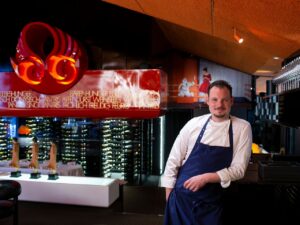
You are currently head chef at Tantris in Munich, a two-Michelin-starred restaurant. Could you describe your role and your main responsibilities?
I am currently Executive Chef at Tantris, in charge of both restaurants as well as the bar’s food menu. My role involves managing the teams, creating menus, sourcing ingredients, and overseeing the financial management of the establishments.
My days begin with receiving and checking deliveries, followed by organising the service with the teams. Each briefing allows us to plan the day precisely: number of covers, special dishes, kitchen organisation… The aim is simple: to be efficient and minimise the unexpected.
I also remain very involved in production, particularly with meat, fish and sauces, which play a significant role in our kitchen with over twenty different preparations made every day.
Even with management responsibilities, I make a point of being in the kitchen every day. For me, a chef must lead by example and stay close to the front line. There are no small tasks; it’s all part of the job. That’s also what I convey to my teams every day: stay involved and never forget the front line.
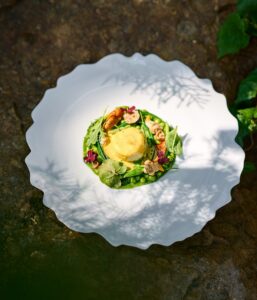 I am currently
 What challenges have you faced in your professional life?
I’ve faced several challenges in my career, but the main one was taking over the kitchens at Tantris, where the clientele is very attached to the restaurant’s identity. I was only the fourth chef since the restaurant opened, and my style of cooking was very different from what previous chefs had offered: more French, with a focus on ingredients and sauces.
The challenge was to get this new vision accepted. It took time for customers to understand my cuisine and feel at home with it. It required a great deal of perseverance, as offering something personal without being immediately understood is never easy. Today, after several years, we have succeeded in building a loyal new clientele whilst evolving the existing one.
Another major challenge is management: leading multicultural teams, with very different profiles, expectations and sensibilities, requires a great deal of adaptability. The role of a chef is no longer limited to the kitchen: you also have to manage people, support them, listen to them and create cohesion between a wide variety of roles that all have to work together to serve the customer.
What are you most proud of professionally today?
My greatest professional achievement isn’t the Michelin stars; it’s my team: I’m also very attached to the people I work with. What matters to me is building a strong team where everyone finds their place and grows.
Ultimately, awards and memorable dishes may linger in the memory, but what truly lasts are the human connections. When former colleagues talk about their experience, what they’ve learnt, and the memorable moments they’ve shared, that’s when I realise the impact of my work. Seeing a close-knit, committed team that enjoys working together despite the demands of the job – that’s my greatest achievement.
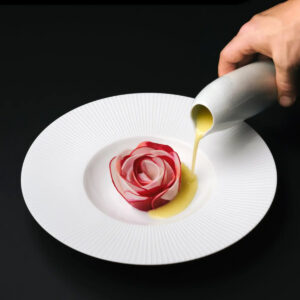 My greatest professional achievement isn’t the Michelin stars; it’s my team: I’m also very attached to the people I work with. What matters to me is building a strong team where everyone finds their place and grows.
What are your ambitions for the future?
Today, my goal is clear: to continue to develop the restaurant, ensure its long-term stability and, why not, one day achieve a third star. It’s a dream, but also a daily source of motivation. The Michelin Guide remains an important benchmark: it’s a point of reference, recognition of the work we’ve done, but also a driving force to keep pushing ourselves further every day.
Beyond the accolades, what matters to me is maintaining the same high standards, continuing to pass on my knowledge to the teams, and always taking as much pleasure in coming to work as I do now.
What would you say to students who want to pursue a career in these fields?
The first piece of advice I’d give is to think carefully before taking the plunge. It’s a demanding job with tough hours, but it’s also an incredibly rewarding profession that offers a wealth of opportunities. It’s a people-oriented job, based on sharing, teamwork and interaction.
But above all, you have to be willing to take the time to learn. These days, many young people want to rush things. Yet in this profession, the basics are essential. Without solid foundations, you cannot build for the long term. With hard work, patience and curiosity, anything is possible.
From his final position at the Auberge de l’Ill to heading up the kitchens at the legendary Tantris in Munich, Benjamin Chmura’s career path following his studies at Institut Lyfe reflects a demanding and passionate approach to the profession. Driven by a constant desire to learn and push his boundaries, he has built an international career within some of the world’s leading gastronomic establishments. Through his experience, Benjamin Chmura also embodies the values championed by Institut Lyfe: knowledge-sharing, excellence and openness to the world. An inspiring journey for future generations of chefs!
Learn more about the Bachelor’s degree in International Culinary Arts Management