







The position of women in the gastronomy and pastry industry
Published on 8 March 2026
Updated on 21 August 2026
Faire défiler la pageOn International Women’s Day, it is essential to consider the place women occupy today in the fields of gastronomy and pastry making. Long perceived as demanding and predominantly masculine, these sectors have been undergoing a gradual evolution in recent years, driven by female professionals who are making their mark through their talent and creativity.
At Institut Lyfe, nearly 50% of students enrolled in the Culinary Arts and Pastry programmes are women. Women are therefore increasingly training for these professions, but their access to positions of responsibility sometimes remains unequal. However, female chefs, restaurant owners, pastry chefs and entrepreneurs are forging their own paths: some have climbed the ladder through experience, while others have quickly risen to key positions early in their careers.
Establishing oneself in a demanding and leadership-driven environment
The world of gastronomy and professional cooking is based on the traditional model of the brigade, where rigour, endurance and high standards have historically shaped the codes of the profession. In this demanding environment, chef positions have long been predominantly held by men, reinforcing certain stereotypes associated with these professions. However, in recent years, attitudes have been shifting towards lasting and positive change. Management practices are changing, leaving more room for collaboration, listening and new forms of management. Today, more and more female chefs are making their mark in gourmet and bistronomic kitchens, asserting their culinary identity and their vision of a new form of management.
The growing visibility of female chefs, driven by professional and media recognition, such as Anne-Sophie Pic, Nina Métayer, Tara Khattar and Jessica Préalpato, is helping to change perceptions and pave the way for new generations wishing to build a career in cooking.
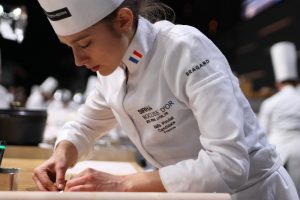 In 2023, Naïs Pirollet, who graduated in 2017 with a Bachelor’s degree in International Culinary Arts Management from Institut Lyfe, became the first woman and youngest chef to represent France in the Bocuse d’Or competition. Although she did not win the Bocuse d’Or 2023, she did win the prize for the best children’s dish on the theme of Feel the Kids. Her greatest pride was not in winning, but in being able to represent France as a female chef in this international competition.
Several graduates of Institut Lyfe have had the opportunity to participate in cooking programmes such as Top Chef (ed: a french culinary programme). This is particularly true of Louise Perrone, who graduated with a Bachelor’s degree in International Culinary Arts Management in 2016 and is co-founder and chef at Rouge in Marseille (France). She has just joined season 17 of the show.
Inspiring journeys, between perseverance and self-affirmation
Behind every female chef or restaurant owner lies a unique journey, often marked by perseverance and a passion for the profession. Many begin their careers in demanding kitchens, where learning involves rigorous technique, technical mastery and experience gained through service. Some professionals then move on to become head chefs, while others choose the path of entrepreneurship by opening their own establishments or developing a culinary concept that reflects their identity.
This is the case for Emily Dader, who graduated with a Bachelor’s degree in International Culinary Arts Management in 2015 and is the founder of Trèfle, a bistronomic restaurant that is committed to both its food and its employees. At the head of a team of 7 employees, she favours a management style based on trust, dialogue and team cohesion.
Emily Roux graduated with the same Bachelor’s degree from Institut Lyfe in 2011. Growing up in a family of restaurateurs with whom she worked for several years, her plan to open her own restaurant gradually took shape: she opened Caractère in London with her partner and, in 2025, was awarded a Michelin star.
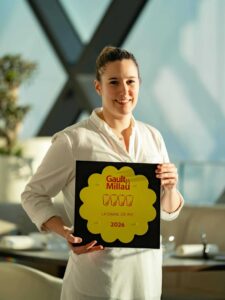 Justine Ravetti, who graduated in 2017 with a Bachelor’s degree in International Culinary Arts Management, has made a name for herself in Anne-Sophie Pic’s kitchens. First in Valence, France, and since its opening in January 2024, in the Dubai restaurant. She arrived as sous-chef and eventually took on full responsibility for the kitchens as head chef. Her professionalism and excellence at La Dame de Pic Dubai have earned her distinctions such as a Michelin star, the Gault & Millau UAE’s Future Great of the Year 2025 award and 4 Toques from Gault & Millau for 2026.
In the field of pastry making, Institut Lyfe can count on its graduates to be entrepreneurial and creative. This is particularly true of Julia Canu, who graduated in 2013 and founded Único Glacier and Fresco Glacier, two ice cream parlours in Lyon city centre where the products are made using traditional methods.
These career paths illustrate how female chefs can flourish in a variety of ways: gourmet or bistronomic catering, innovation in the ice cream industry, experiences in France and abroad… The possibilities are endless for graduates of Institut Lyfe. Today, success in the kitchen no longer follows a single model, but is achieved through a variety of paths, driven by different personalities and visions of the profession.
In the gastronomy sector, there are an increasing number of female Michelin-starred chefs: in 2025, there will be 40 women with Michelin stars in France, compared to 22 in 2022 and only 27 in 2019. Each new star awarded to a female chef confirms a steady evolution in the haute cuisine sector.
The new generation of female chefs
In higher education institutions such as Institut Lyfe, a new generation of future female chefs is already preparing to change the rules of the profession. More and more female students are choosing careers in gastronomy or pastry making with clear ambitions. For the 2025-2026 academic year at Institut Lyfe, 50% of students in the Culinary Arts and Pastry programme are female. Female students do not wish to settle for entry-level positions but naturally aspire to positions of responsibility, entrepreneurship or international careers.
This new generation also brings a fresh approach to kitchen management: as Emily Dader shares in an interview, ‘younger generations are more aware of their rights and their limits: they are pushing the sector to change.’
Female chefs such as Manon Fleury (founder of Datil in Paris and co-founder of the Bondir.e association) and Pauline Legal (independent pastry chef and President of the Femmes Cheffes association) are championing women’s place in the gastronomy industry. These associations are supporting a gradual transformation of the sector, enabling women to gain greater recognition and visibility for their skills.
In 2026, gastronomy and pastry are increasingly enriched by female talent: women are pushing boundaries, reinventing the codes of gastronomy and pastry-making, and demonstrating boundless creativity. Their success is proof that the sector is becoming more inclusive and welcoming to all talents. For all young women who dream of joining a top team or opening their own establishment, the message is simple: your place is where you want to be, and your talent, daring and creativity are your best allies for making your mark in the world of gastronomy and pastry-making.